“WE’RE EASY TO WORK WITH”
How many times have you heard that? Then the contract lands in your inbox and suddenly you’re wading through 97 pages of dense legal jargon, one-sided indemnities, and clauses that would make your lawyer (i.e., me) wince. But what about you – what does your contract say about your business?
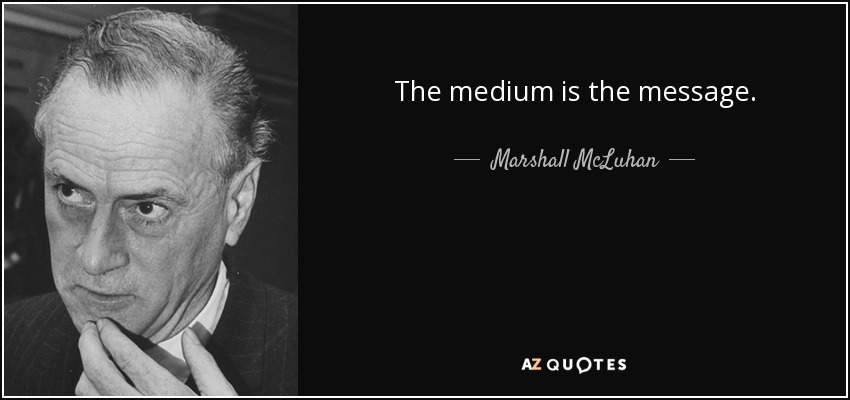
I’ve been reading Marshall McLuhan’s 1964 classic “Understanding Media”. McLuhan, a Canadian philosopher, was interested in the impact of mass media on humanity, particularly how different forms of media influence our responses to the content of communication. One of his most famous ideas was this:
THE MEDIUM IS THE MESSAGE
McLuhan was intrigued by the notion that the form of a communication (i.e., the medium) embeds itself in the message, fundamentally shaping the thoughts and beliefs of the audience separately to the content being shared.
That got me thinking about how business contracts are a medium of communication. Your contract is often one of the earliest interactions you’ll have with a commercial partner. So what do your contracts say about your business?
We’re collaborative and easy to work with… or are we 🤔
New clients often emphasise to me that strong relationships are the backbone of their business. They tell me that the secret to their success is how easy they are to work with… but their standard legacy contracts tell a completely different story. A dense, aggressive or unreadable contract does not scream “collaborative, reasonable and forward-thinking”.
Construction and mining services are just as cyclical as any other market. It frustrates me when the party in the stronger market position hands over a brutal contract and says “This is our standard corporate position and no one else has a problem with it. Take it or leave it”. It’s particularly galling when the other party lacks the knowledge, confidence or bargaining power to push back. Claiming to “value teamwork” while exploiting a market imbalance is jarring, not to mention at odds with the unfair contract terms prohibitions in the Australian Consumer Law.
You might believe you’ve built fabulous rapport with your new client or supplier. But what happens when you present them with a nasty contract full of legal gibberish? You instantly create a trust deficit, no matter how well the relationship was warming up. We all know how hard it is to build trust.
We want creative and innovative suppliers… or do we 🤔
The risk allocation in your contract tells a tale about your business priorities.
Your tender document says that you welcome non-conforming tenders and you want your supplier to work with you to value engineer an innovative solution. Then you serve up a punishing contract with a massively one-sided indemnity and 5 pages of warranties that shift all the risk (and then some) to the supplier. Some suppliers will scuttle it at the “go/no-go stage” and not bother to tender. Others might serve up a bland, low risk design, because they can’t price or manage the risks your contract creates.
Maybe some suppliers will price the risk, but will that price be a genuine expression of the value of the purchase? If you require suppliers to price and insure a horrible liability regime, you might end up paying a premium because your contract slugs your supplier with the risk of something that probably won’t ever happen.
We’re modern and forward thinking… or are we 🤔
Plain English contracts exist. Businesses that continue using complicated, old fashioned contracts weighed down with dense legalese are making a deliberate choice. At best, they are telling commercial partners that they haven’t bothered updating their contracts for 10 years and have no idea what either the law or the market has done during that period. At worst, it shows that their entire business is stuck back in the 20th century, and they have no interest in joining the rest of us up here in 2026.
Why it matters
Old fashioned, complicated contracts full of legal gibberish don’t represent your business well. They create friction at the start of the relationship, take longer to negotiate, and are harder and more expensive to administer. Worst of all, they plant the seeds of disputes before the work has even begun.
A contract aligned with your values looks quite different. It’s short, readable, and expressed in plain English, ideally in the first person. It balances risk properly and sets out clear obligations on both sides. No one needs a law degree to understand what it says.
Your contract is always saying something. Make sure it’s saying what you mean.